
marketing leadership
lead generation
marketing strategy


The marketing industry skips the most important step. Here's what that costs women fractional executives... and how to stop paying for it.
I was on a Q&A call, three months into another mentoring program. I’d been doing the work, posting consistently, following the formula, showing up, and still getting nothing back. No nibbles, let alone bites.
Of course I thought I was doing something wrong.
But sitting in that call, I started looking around.
I noticed nobody in the group had results. Not one person. And while workshopping my content, the coach (after validating that yes, I was doing all the right things) finally said, “Well, it might be that you’ve already exhausted your existing audience. You may need to try lead generation.”
I’d spent over $10,000 and three months to be told that the thing I needed wasn’t part of the program.
The frustration, the waste, the exhaustion of starting over. I still carry it.
Not as a wound (OK, maybe a little bit of a wound), but as a compass. Because that moment taught me something I now consider non-negotiable:
You cannot solve the right problem if you haven’t diagnosed it first.
Here's the pattern I see repeated constantly in the marketing space: a founder comes in with a problem. The provider leads with a solution. Not because the solution is right, but because it's the solution that provider knows how to sell.
Content coach? The answer is more content.
Social media strategist? The answer is a better posting cadence.
Email marketer? The answer is a nurture sequence.
None of these providers is necessarily wrong. The tactics they teach can work. The problem is that they skip the most important question: Is this actually the problem you have?
When a doctor prescribes medication before running any tests, we call that malpractice. In marketing, we call it a program.
.png?width=1584&height=396&name=Blog%20quote%20-%20malpractice%20(1).png) The result is that founders end up with:
The result is that founders end up with:
More tactics layered onto a foundation that was never solid to begin with
More content on a platform that isn't where their buyers actually spend time
More emails to a list full of people who were never the right fit
More visibility without any of the foundational pieces in place to turn that visibility into pipeline.
And when it doesn't work, the industry's answer is almost always the same: you need to be doing MORE of it.
Post more often. Show up more consistently. Try harder.
If you've been in this position, you know what that cycle feels like.
You do more.
You try a different platform, a different format, a different posting schedule. You invest in another program that promises to fix the thing the last program didn't address. You keep expecting that eventually, the effort will compound into something reliable.

Meanwhile, the pipeline never stabilizes, and revenue remains unpredictable.
Every slow month raises the stakes on all the decisions you've been putting off: whether to hire, whether to raise prices, whether you can afford to say no to a client who isn't quite the right fit.
The cost of a wrong diagnosis isn't just the money spent on the program. It's:
The months of effort applied to the wrong problem.
The decision fatigue that comes from second-guessing your messaging, your positioning, your strategy, when the real issue was never any of those things in isolation.
The slow erosion of confidence that happens when you've been consistent and nothing has changed.
Most founders who come to me have been through at least one version of this. Often more than one.
They are not people who quit easily or don't follow through. They are people who have gone all in on a plan that wasn't built around their specific situation.
The marketing industry runs on pattern matching.
A provider sees a founder who isn't getting clients, and they recognize the surface-level symptoms: inconsistent posting, unclear messaging, no email list. So they prescribe the thing that addresses those symptoms, because that's what they know how to do.
What rarely happens is the deeper question: Why are those symptoms present? What's the structural issue underneath them?
Sometimes the problem really is messaging. Sometimes it's that the offer is too vague for the founder's ideal buyer to self-select. Sometimes the referral network has been the only lead channel for years and it's quietly shrinking with nothing behind it. Sometimes the visibility efforts are working but there's no system to capture or follow up with interest.
Each of those situations requires a different solution.
Applying the same tactics to all of them doesn't work. It produces activity that never goes anywhere, and founders who feel like they're doing everything right but still can't figure out what's wrong.
When I start a new engagement, the first thing I do is diagnose. Not assume. Not prescribe. Diagnose.
That means asking:
What has already been tried, and what did it produce?
Where is lead flow breaking down — at awareness, at conversion, at follow-through?
What does your current pipeline look like, and where does it depend too heavily on your personal network and energy?
Most of the time, the problem isn't that you haven’t tried hard enough. It's that the problem you’ve been trying to solve isn't the problem you actually have.
When:
The ICP needs sharpening
The messaging doesn't map to how your best clients speak about the problem
The existing content is creating awareness but there's no system to move interested people any further
These are structural issues.
They don't respond to just churning out more content; they respond to a different approach built around what's specifically broken.
That's the core behind my framework, Consistent Leads Blueprint: Diagnose. Design. Build. Iterate. Transition.
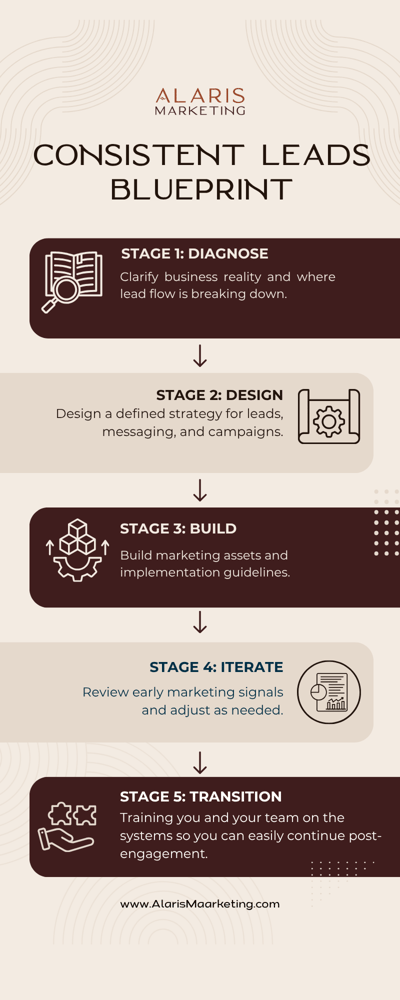
The diagnosis comes first, every time, without exception. Not because it's a nice differentiator, but because I paid $10,000 to learn what happens when you skip it.
If you're reading this and recognizing the pattern — you've tried the advice, followed the formula, done the work, and the pipeline still isn't reliable — the next step isn't another tactic.
It's figuring out where your lead flow is actually breaking down.
The Consistent Leads Scorecard is a free tool designed to help you do exactly that. It walks you through the key structural areas of a lead generation system and helps identify where the breakdown is most likely happening in yours.
It takes about ten minutes. What you walk away with is a starting point for a real diagnosis instead of more generic advice about what to try next.